
What’s the Best Way to Share STI Test Results With a Partner?
Share the results and context that matter, in a way you both agree to, without automatically sending the original lab report.


You ask someone you’re dating if they would be willing to share their STI test results. They hesitate.
Is that reasonable, or should you be concerned?
Before you decide what their hesitation means, it helps to separate two different requests. Asking someone to share relevant STI test information is not the same as asking them to send you a medical record containing their name, date of birth, provider details, and unrelated results.
You are not wrong for wanting meaningful information before intimacy. They are not wrong for wanting to protect the rest of their medical record. Start with positive intent. Their concern may be about privacy, not about keeping relevant information from you.
That does not mean setting your own boundaries aside. You still get to decide what information you need before moving forward. The question is whether you can exchange enough credible, current information without either person exposing more than the moment requires.
Velvet Verify is designed for that exchange. It lets two people share relevant results through a mutual, time-limited connection without automatically sending each other the original lab report.
What STI test information should you share before intimacy?
You do not need each other’s complete medical histories. You just need answers to a few useful questions before deciding what happens next.
A useful exchange can include:
- What each person was tested for
- What each result says
- When the sample was collected, not just when the result arrived
- Where the sample was taken from, when that matters
- Whether anything happened after testing that could change the picture
That last point matters because a result describes a particular test at a particular time. It does not promise that nothing changed afterward. Some tests also have a window period during which an infection may not yet be detectable. Window periods vary by infection and test type. The CDC’s HIV testing guidance (opens in a new tab), for example, explains how different HIV tests have different window periods.
You do not need every available detail. You need enough context to understand what the results can and cannot tell you.
Can you share STI results without sending your medical record?
Yes. You can share useful STI test information without sending the original document.
Lab reports were not written for date night. They can be dense, hard to interpret, and packed with information that has nothing to do with the decision you are making together. A page containing STI results may also show your legal name, date of birth, provider details, contact information, billing information, or unrelated test results.
Send the whole page and you may reveal more than you intended. Crop or redact it and you may remove the context that makes the result understandable. Text a screenshot or PDF and that private document can sit in someone else’s messages indefinitely.
Wanting credible information before intimacy is reasonable. So is not wanting a new partner to keep a permanent copy of your medical record. Neither person is wrong, and you should not have to choose between trust and privacy.
Being ready for intimacy is not the same as sharing your medical record
Someone can feel ready to become physically intimate before they feel ready to hand over lasting access to sensitive health information. Those are two different kinds of vulnerability. Being comfortable with one does not automatically mean agreeing to the other, and that is not a contradiction.
And wanting more than a verbal “I’m good” is not an insult. You get to decide what information you need before sex. The other person gets to decide what they are comfortable sharing. Both boundaries can be valid.
Privacy and honesty are not opposites. When people can share the answer that matters without exposing their full records, being open becomes easier.
The exchange should feel mutual. One person does not need to become the inspector while the other proves themselves. You both decide whether to connect, what to share, and whether you have enough information to move forward.
How to share STI test results using Velvet Verify
Velvet Verify gives you a shared process instead of leaving you to improvise:
- Add your results. Each person can add their own STI test results to Velvet Verify.
- Connect and share. Once the two of you connect, your results become visible to each other for 24 hours. There is no additional sharing step.
- Review the relevant results. Each person sees the shareable information inside Velvet Verify without automatically receiving the other person’s original document.
- Let the sharing window close or open a new one. Either person can request another sharing window. It opens when the other person accepts, which also lets ongoing partners exchange updated results as they continue testing.
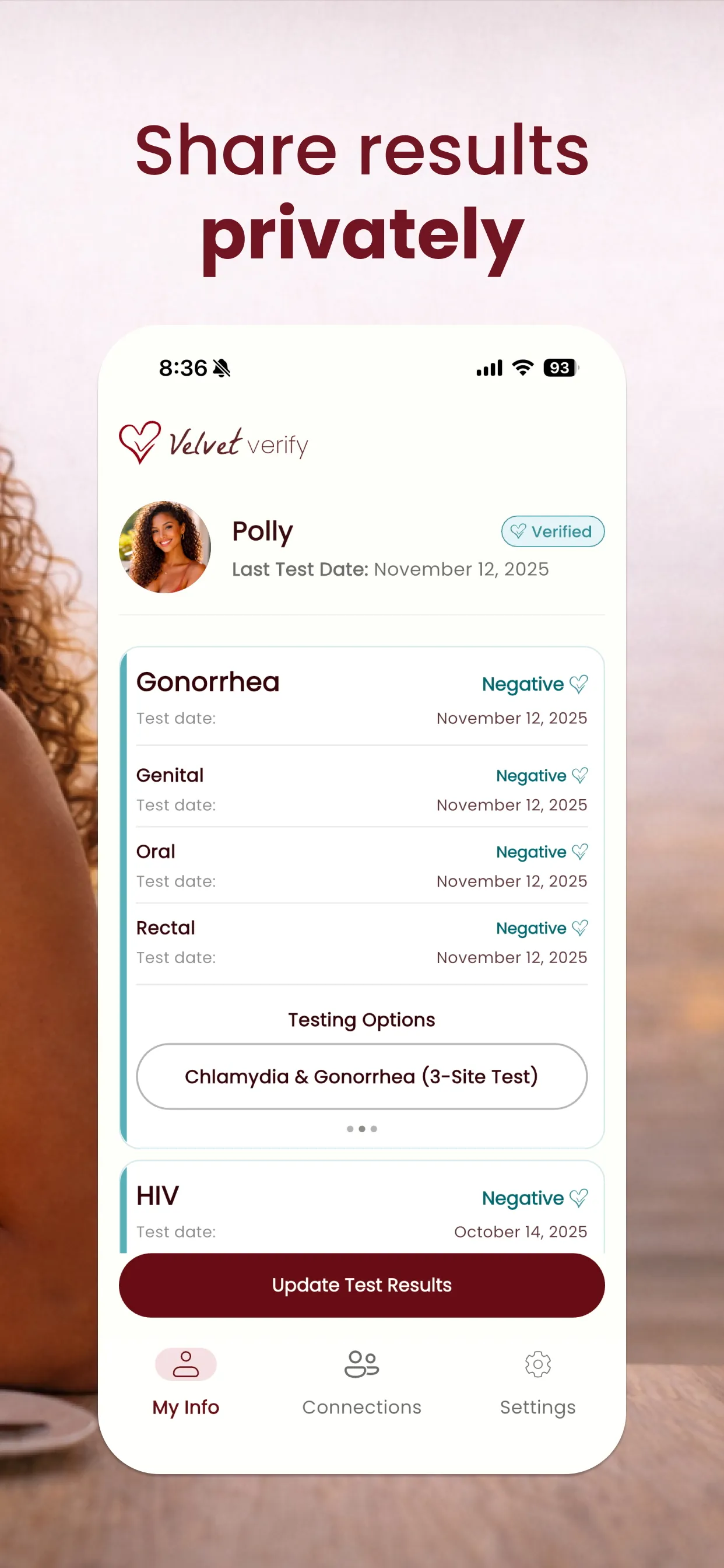
Velvet Verify keeps the original medical document behind the scenes. Here is what stays separate:
- The document Velvet Verify checks behind the scenes
- The relevant, structured information you choose to share with your partner
- The personal and clinical context you still talk through together
That structured view gives the other person more reason to trust what they see than an unexplained screenshot. They do not have to inspect a medical document they may not know how to read. You get a clearer exchange without automatically passing around the underlying record.
The sharing window limits future access inside Velvet Verify. It cannot promise that someone did not separately capture what they saw while the information was visible. Its purpose is to avoid automatically transferring a permanent copy of the underlying medical record.
That is trust without unnecessary exposure.
What does “Verified” mean here?
Here is the precise part. Velvet Verify examines an uploaded document for common authenticity markers, internal consistency, and whether it can reasonably be attributed to the person sharing it. When the document passes those automated checks, eligible negative results can receive a Verified status.
That status is useful, but intentionally limited. “Verified” does not mean someone is STI-free, medically cleared, or guaranteed to be unable to transmit an infection. It does not confirm the clinical accuracy of the laboratory result, replace a healthcare professional, or make a dated result permanently current.
And “Not Verified” is not an accusation that someone is dishonest. It means Velvet Verify does not have enough support to apply the Verified label.
What still belongs in the conversation?
An app can make the exchange clearer. It cannot make the decision for you. You may still want to discuss when testing happened, whether anything relevant occurred afterward, what protection you plan to use, and what each of you needs to feel good about moving forward.
The point is a more useful and thoughtful starting point, with the limits left clear.
You already handled the first step by asking. Now you can exchange what matters without turning the moment into a medical-record review.
Frequently asked questions
How recent should STI test results be?
There is no one magic number. What matters includes when the sample was collected, what was tested, the type of test, and whether a possible exposure occurred afterward. A qualified healthcare professional can help with questions about your individual testing needs and timing.
What happens when Velvet Verify sharing ends?
Results remain visible inside Velvet Verify for 24 hours after two users connect. Either person can request a new sharing window, but it only opens when the other person accepts. Ending in-app access does not delete anything someone separately captured while information was visible.
What if my provider only gave me a message or phone call?
Ask the provider how to get your own documented results. Formats vary, so not having a conventional report should not automatically be treated as suspicious.
Not sure how to bring it up, or want to revisit the conversation? Read Are You Velvet Verified? for a simple way to talk about testing before intimacy.