
How Do I Tell Past Partners I Tested Positive for an STI?
Notifying past partners about a positive STI result can be complicated. Here's how to approach it, protect your privacy, and understand your options.


Testing positive for a sexually transmitted infection (STI) can be stressful enough. But once you’ve addressed your own health, another question may arise: How do you tell past partners who may have been exposed?
We’ve covered how to tell a current partner you’ve tested positive for an STI.
That guidance applies here, too. But past partners present additional challenges. You may not know who needs to be contacted, how to reach them, or whether doing so could compromise your privacy. The good news is that you have options, including some that don’t require personally contacting everyone.
How far back should I notify partners after a positive STI test?
The answer depends on the infection, your testing history, and when you may have acquired it. For example, the CDC recommends (opens in a new tab) that people diagnosed with chlamydia notify sexual partners from the 60 days preceding symptoms or diagnosis. If their most recent partner was more than 60 days ago, that person should still be evaluated.
Other infections have different recommendations, and many STIs can remain asymptomatic, making it difficult to determine when an infection occurred. Your healthcare provider can help identify which partners may need to know. Remember, a positive result doesn’t necessarily tell you who transmitted an infection or when.
The objective isn’t to assign blame. It’s to give people who may have been exposed an opportunity to seek appropriate care.
Why telling past partners about an STI can be difficult
Perhaps you had a casual encounter with someone whose last name you never learned. Maybe you’ve lost contact with an ex, or a previous relationship ended badly. Even when you have someone’s contact information, reopening communication can be uncomfortable. You may face questions, accusations, or emotionally difficult conversations, potentially with several people.
And there’s another important consideration: your privacy. Every person you tell about a positive STI result learns something sensitive about your health. You can’t necessarily control whether they share that information with others. For someone who has experienced harassment, coercion, or abuse, contacting a former partner could even create a safety risk.
Wanting to protect your privacy doesn’t mean you don’t care about your partners’ wellbeing. It means you’re balancing their need for relevant health information with your own right to confidentiality and safety. Fortunately, you don’t always have to handle notifications yourself.
Ways to notify past partners about an STI
Several services can help, but each faces challenges that have become increasingly apparent as the way people communicate has changed.
Can a health department notify my partners for me?
Many health departments employ Disease Intervention Specialists (DIS) who help identify and notify people potentially exposed to certain STIs. These professionals can contact partners without revealing who tested positive, helping protect your identity while connecting others with testing and treatment resources.
However, availability varies. According to the CDC’s guidance on partner services (opens in a new tab), health departments routinely prioritize infections such as syphilis and newly diagnosed HIV, while relatively few provide routine services for chlamydia and gonorrhea.
Resources are another challenge. As we explored in our article on why asking partners about STI testing matters, federal STI-prevention funding has lost substantial purchasing power over the past two decades.
And even when trained professionals are available, reaching someone isn’t straightforward. Unknown numbers go unanswered. Emails disappear into spam folders. Legitimate health notifications can be mistaken for scams. The CDC acknowledges these challenges (opens in a new tab) in its guidance on internet-based partner services.

Anonymous STI notification services
Some websites allow people to send anonymous STI-exposure notifications by text or email. These services can be useful, especially when someone fears a difficult reaction. But receiving an unexpected message about an STI exposure from an unidentified sender can understandably raise suspicions.
Is it legitimate? A scam? Someone trying to embarrass or frighten you?
Systems that don’t establish whether a notification is genuine can also be misused to harass others. The CDC recognizes the potential for false or prank notifications (opens in a new tab).
These aren’t necessarily failures of the services themselves. They’re consequences of trying to communicate sensitive health information in an environment where unsolicited messages are increasingly difficult to trust.
Can dating apps help with STI partner notification?
Dating apps introduce another challenge: What happens when you no longer have a way to contact someone? Perhaps you connected through Grindr or Tinder, had sex, and never exchanged phone numbers. Months later, their profile is gone.
A 2022 CBS News report (opens in a new tab) described public-health workers attempting to contact people through dating platforms, sometimes without formal support from the platforms themselves. Privacy concerns are legitimate. Dating services shouldn’t indiscriminately disclose who their users have interacted with.
But even if every dating app introduced exposure notifications, would that solve the problem?
Someone might meet partners through Grindr, Feeld, Tinder, and in person. Would they need to upload test results and manage notifications separately across every platform? The fragmentation extends beyond dating apps. People use different laboratories, clinics, at-home testing services, and treatment providers.
Sexual health doesn’t exist within the boundaries of any single dating app, laboratory, or healthcare system. Why should sharing relevant information depend on one?
A Different Approach: Connecting Before You Need to Notify
Most partner-notification methods begin after someone tests positive. By then, they must remember who they were with, figure out who may have been exposed, and find a way to reach them.
What if that connection had already been established?
That’s part of why we created Velvet Verify.
Velvet Verify is a privacy-first sexual-health app that lets people share relevant STI-testing information and opt in to anonymous exposure alerts, independently of where they met or received medical care.
Think of it as a trusted intermediary between sexual partners, dating platforms, and testing providers.
The idea is simple:
You meet someone, whether through a dating app, at a party, or anywhere else. You can connect through Velvet Verify before or after an encounter and privately exchange STI-testing information.
The system extracts relevant information from uploaded test results, inspects documents for authenticity, and allows you to confirm the information before the original document is deleted.
You can also choose to receive future exposure notifications from that connection.
Those alerts are entirely opt-in. You must explicitly choose to receive them for a particular connection. You’re not receiving an unsolicited message from an unknown sender; you’re using a service you’ve already agreed to trust for that purpose.
Now imagine that months later, one of you reports a positive STI result.
Velvet Verify uses available testing dates and logged encounter information to evaluate which opted-in connections may need to be notified. Eligible recipients can receive automatic, anonymous alerts without identifying the person who reported the result.
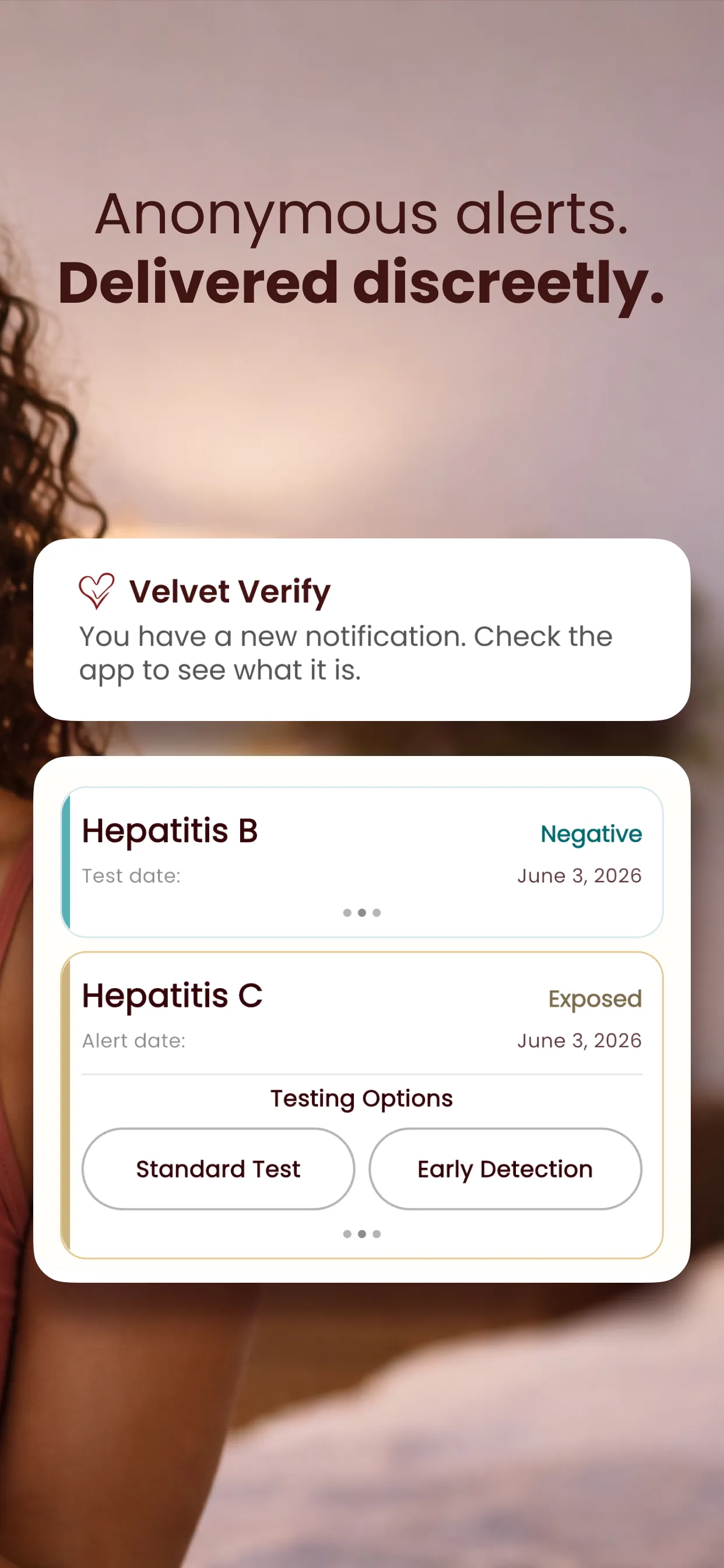
A notification doesn’t establish that transmission occurred or guarantee that the underlying result was independently verified. And while alerts don’t disclose the reporting person’s identity, anonymity cannot eliminate every possibility of someone inferring who reported an infection.
But the people involved don’t need to rediscover each other.
It doesn’t matter whether someone changed their dating-app username, deleted their profile, or never shared their phone number.
And the person dealing with a positive diagnosis can focus on getting the medical and emotional support they need rather than navigating a complicated web of past relationships.
Velvet Verify only works for connections established through the app, and notifications depend on people opting in and providing the relevant information. It isn’t a replacement for public-health partner services or direct communication.
It’s another way to help people accomplish the same underlying objective: sharing information that could help someone protect their health.
Looking Out for Others Without Sacrificing Your Privacy
If you’ve tested positive for an STI, talk with your healthcare provider about which past partners may need to know and whether confidential notification assistance is available.
You don’t have to navigate every conversation alone.
At Velvet Verify, we believe sharing sexual-health information should become a normal part of connecting with a partner, regardless of how or where people meet.
Because the best time to establish a trusted way to communicate a potential exposure is before anyone needs to send one.
Taking responsibility for your sexual health should include looking out for others. It shouldn’t require sacrificing your own privacy to do it.